
We owe it to Peter and Paul that Christianity did not become—and remain in its early years—an irrelevant Jewish sect. Peter, as leader of the group of the Twelve, was the factor of unity and cohesion; his authority and leadership among the first Christians guaranteed fidelity to the teaching and the historical experience lived with Jesus of Nazareth.
Paul, for his part, played a leading role and represented the expansion of Christianity, breaking down the cultural barriers of Judaism so that the Gospel, through its structure, philosophical-theological systematization, and universal missionary vision, would reach the Greek and Roman world of that time.
The experience of Peter and Paul in the first Christian communities remains valid and necessary for the existence and work of today’s Catholic Church. Because we need “Peter” to maintain unity in the communion of faith and tradition. The successor of Peter avoids, at every moment in the history of the Church, the fragmentation of the universal Church.
Paul’s witness and example, for its part, prevents the Church, today and always, from becoming self-referential and becoming “a museum without a future.” It is the “Pauline and missionary principle” that pushes the Church to the existential peripheries so that the light of the Gospel may reach everyone. It is the figure of Paul who will continually remind the Church to live in a constant state of evangelizing ‘outreach.’ But both Peter and Paul always remind us that the center of the Church is Jesus Christ.
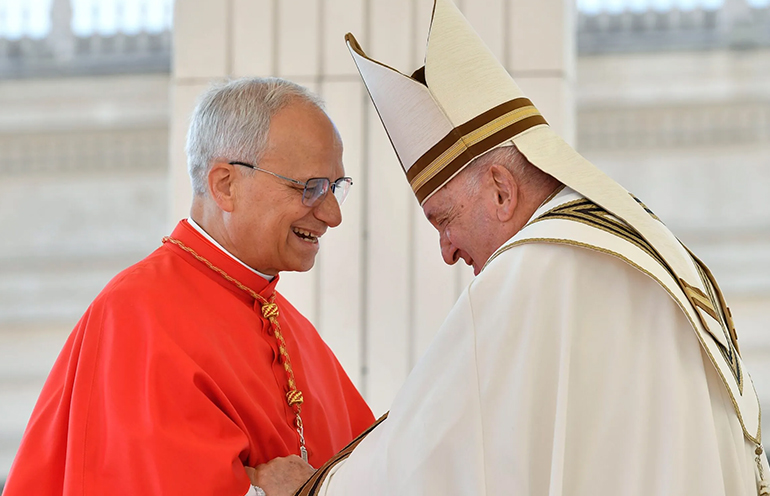
The last fifteen years of human history have been marked by dizzying changes across all areas of life: political, economic, cultural, scientific, and technological. It has been fifteen years in which Catholics and all humanity have had the guidance of two Popes: Francis and, currently, Leo XIV. Two Popes who, responding to the challenges posed by these changes, steer the Barque of Peter through the ups and downs and uncertainties of our present history.
If Francis’ legacy (2013 – 2025) can be summed up as the Pope for a “Church of Outreach,” Leo XIV is emerging as the Pope of “ecclesial institutional consolidation” and a bridge between the New World and new cultures within the Roman Catholic tradition.
Francis’ pontificate “made a mess,” disrupting the Church and moving from moralistic positions to a language and actions of mercy and support for what he himself called the human or existential peripheries, in need of the love and light of the Gospel. Leo XIV has focused on this, his first anniversary of the pontificate, on “putting the house in order,” converting Francis’ reforming and prophetic positions into solid juridical structures and institutions.
Francis preached the Church as a “field hospital” and a “theology of the people and for the People of God,” giving priority to praxis over doctrine. Leo XIV seeks an Augustinian synthesis between faith, reason, and the institutional order. Francis made a direct and political prophetic denunciation of world problems; Leo XIV strives for discreet diplomacy and the most academic tone.
Francis convoked the “Synod on Synodality” as a call to all to a social and political friendship in dialogue and to the Church to walk together, in communion and participation that is more horizontal and less pyramidal. Leo XIV seeks “unity in truth,” to prevent a misunderstood diversity from turning into dispersion and ruptures.
The convocation of the Franciscan Year 2026 by Leo XIV demonstrates fidelity to the paths opened by his predecessor while seeking to ensure that the message is built in an orderly and sustainable way. Francis linked the social crisis with the environmental crisis and called for respect and care for an integral ecology, criticizing the global economic system. Leo XIV takes up the Social Doctrine of the Church but insists that peace begins with the disarmament of the heart.
We moved from the Pope who deepened the “preferential option for the poor” of Puebla, coming “from the ends of the earth,” to the “option for communion” of a Pope who combines his origins and knowledge of North American society with the realities of Latin America and the South, owing to his years of missionary experience in Peru.
Thus, Francis and Leo XIV, as in their time Peter and Paul, have been shaping the best presence of the Church in today’s world, with its postmodern challenges of polarization, truth, and meaning, in addition to the impact of technological advances on human beings and on coexistence.
And since comparisons are simplistic, because they forget the complexity of the human being and social situations, we congratulate ourselves, we pray for them, and we thank God for the Francis-Leo XIV binomial. Because each one, with his respective origins, style, training, and emphasis, offers the Church and the world of our days a necessary and complete response for coherence, listening, and the struggle for human dignity, from the logic and criteria of the Good News of Jesus of Nazareth.
